
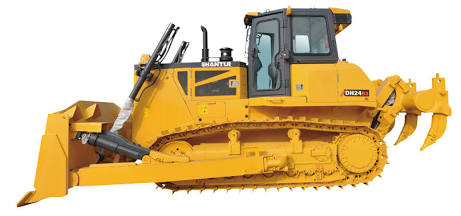
Hydrostatic vs. High-Drive: A Deep Technical Review of the Shantui DH24-B3 XL and Cat D7 An Engineering Analysis of Drivetrain Dynamics, Structural Design, and Lifecycle TCO In the 240-to-265 horsepower crawler tractor class, procurement decisions traditionally pivot on legacy footprints. The Caterpillar D7 is an industry benchmark, famous for its elevated sprocket “High-Drive” architecture and high-tier electronic telemetry. However, engineering and fleet asset managers evaluating production economics must look closer at structural and drivetrain dynamics rather than brand prestige. The Shantui DH24-B3 XL challenges this space by applying a fundamentally different mechanical philosophy. By replacing a complex torque-converter power-shift transmission with an electronically controlled hydrostatic system, it creates unique advantages in power-transfer efficiency and application versatility. Below is a granular technical breakdown comparing the engineering mechanics of the Shantui DH24-B3 XL against the Cat D7. 1. Drivetrain Architecture: Linde Hydrostatic Drive vs. Cat Mechanical Power-Shift The core differentiator lies in how engine power is translated into drawbar pull. The architectural contrast here dictating fluid power efficiency is significant: The Caterpillar D7 System: Employs a mechanical powertrain utilizing a torque converter paired with a multi-speed planetary power-shift transmission. While providing strong momentum in linear dozing cuts, it inevitably suffers from parasitic torque converter slippage under high resistive blade loads. The Shantui DH24-B3 XL System: Implements a dual-path, dual-circuit, electronically controlled hydrostatic travel drive system developed with premium hydraulic component groups (Linde technology). This eliminates the torque converter, driveshafts, and transmission gearboxes entirely. From an engineering standpoint, the hydrostatic advantage alters site productivity. The system delivers completely stepless, infinitely variable speed regulation up to peak velocity. Under extreme blade resistance, the hydrostatic pressure automatically increases to match the load requirements without dropping engine RPM or forcing a physical gear change. Furthermore, it enables counter-rotation of the tracks and full power-turns, allowing the DH24-B3 XL to maneuver in tight geometries where a power-shift dozer loses track traction and momentum during steering clutch disengagement. 2. Engine Displacement & Torque Dynamics When analyzing the torque profiles under peak drawbar load, engine displacement and injection stability become paramount. Engineering Dimension Shantui DH24-B3 XL Spec Caterpillar D7 General Target Spec Engine Platform Weichai WP12 Heavy-Duty Diesel Cat C9.3B Engine Platform Rated Net Power 185 kW (248 hp) @ 2100 rpm Approx. 197 kW (265 hp) @ 2200 rpm Operating Mass Approx. 23,800 kg to 26,400 kg (configuration dependent) Approx. 29,700 kg Standard Blade Volume 6.5 m³ to 6.9 m³ (Semi-U Option) Approx. 6.6 m³ to 7.4 m³ The Weichai WP12 platform utilized in the Shantui DH24-B3 XL features a large, high-displacement 11.6L 6-cylinder layout. While the Cat D7 relies on highly complex, high-pressure common-rail tuning (C9.3B) to maximize power density from a tighter displacement, the Weichai block leverages raw displacement size to generate high continuous torque at low thermal loads. For operations in remote territories, the direct-injection, turbocharged configuration provides massive tolerance for fuel quality variations that would choke or score the precise electronic injectors found on Tier 4 Final / Stage V common-rail networks. 3. Structural Load Paths: Conventional Chassis vs. Elevated Sprocket The Cat D7 uses the iconic elevated sprocket design. This geometry successfully removes the final drives from ground-shock loads, but it adds secondary idlers and introduces a high center of gravity, which can accelerate track bushing wear during repetitive reverse high-speed tracking. Shantui adopts a low-drive, conventional rigid crawler chassis frame. The ground contact length is optimized at **3,050 mm** with a standard track shoe width of **560 mm** (up to 660 mm available). This provides a ground contact profile specifically optimized for stabilizing the massive **6.9 m³ Semi-U blade**. Because the final drive centers are low and in-line with the track roller frame, the structural load paths pass linearly into the ground during heavy dozing cuts, minimizing vertical oscillation and track chain snaking. The Metallurgy Factor: Shantui manufactures its own structural undercarriages—supplying heavy components globally to premium Western brands. The steel alloys and deep heat-treatment cycles utilized on the DH24-B3 XL pins, bush assemblies, and idlers are fundamentally engineered to combat high abrasive soil conditions. Lifecycle Operational Cost & Field Maintainability Comparison When procuring assets for demanding mining, road building, or quarry projects, the operational cost calculation extends far beyond initial fuel metrics: 1. Eliminating Software-Based Downtime The Cat D7 requires a proprietary electronic software suite for basic drivetrain calibration and troubleshooting. A field sensor failure on an exhaust fluid circuit or telemetry module can immediately force the dozer into “derate,” bringing production to an absolute halt until a factory technician clears the software lockout. The Shantui DH24-B3 XL balances electro-hydraulic controls with clear mechanical architecture. Machine parameters are displayed via an intelligent touchscreen instrument monitor that features onboard self-diagnostics and open fault isolation, allowing a standard heavy equipment mechanic to repair faults right in the field. 2. Drivetrain Component Commodity Replacement Because Shantui partners with premium global specialized suppliers like Linde for hydraulic travel components and Weichai for heavy diesel engines, the core drivetrain parts do not carry a restrictive proprietary markup. Over a 10,000-hour machine lifecycle, sourcing hydraulic pump cartridges, motors, and engine overhaul components through open distribution models reduces standard maintenance costs significantly compared to exclusive OEM supply chains. 3. Lower Initial Capital Risk Amortization costs directly dictate project bid margins. A hydrostatic dozer like the DH24-B3 XL often enters a fleet at an initial purchase price 35% to 45% lower than a comparably configured D7. When calculating the asset depreciation alongside its high 6.9 m³ dozing capacity, the Shantui machine frequently delivers a superior net cost-per-cubic-meter ratio, making it a compelling, reliable choice for modern fleet managers focused on operational profitability.
The Smart Alternative: 3 Reasons the Shantui SE220 Excavator Defies Premium Price Tags
The Smart Alternative: 3 Reasons the Shantui SE220 Excavator Defies Premium Price Tags A Data-Driven Technical Overview & SEO Performance Guide for Fleet Operations When procuring a 22-ton hydraulic excavator for your fleet, it is incredibly easy to fall into the brand-name trap. Most fleet managers instinctively look toward the Caterpillar 320 or Komatsu PC210, assuming that a higher upfront price tag automatically translates to a superior machine. However, if you shift your focus from brand prestige to Total Cost of Ownership (TCO), hydraulic efficiency, and uptime, the Shantui SE220 emerges as a fierce competitor. Shantui may be globally famous for its “King of Earthmoving” bulldozers, but they have quietly revolutionized their excavator lineup by applying the exact same heavy-duty engineering philosophy. Here are 3 structural and technical reasons why the Shantui SE220 excavator is a smarter investment than its premium-priced competitors. 1. Golden Powertrain Integration: Cummins + Kawasaki A common critique of alternative heavy equipment brands is that they use mismatched or lower-tier powertrain components to save on costs. Shantui rejects this approach entirely. The SE220 features what earthmoving mechanics refer to as the “Golden Drivetrain Combo.” The Engine: The SE220 is powered by a robust, turbocharged Cummins B5.9 (or QSB6.7 depending on regional emission tiers) engine. It delivers a reliable 150 HP (112 kW) at 1950 RPM. Because it uses a highly efficient fuel filtration system with a multi-stage water separator, it is notoriously resilient against the varied fuel quality found on remote job sites. The Hydraulics: Instead of using proprietary, closed-source hydraulic pumps, Shantui equips the SE220 with world-renowned Kawasaki main pumps and a Kawasaki control valve. Instead of dealing with laggy, uncoordinated movements, operators get the exact same buttery-smooth multi-function control (boom raise, arm crowd, and swing simultaneously) that they would expect from a machine costing 40% more. 2. Advanced Hydro-Electronic Control (Up to 15% Fuel Savings) Where the Shantui SE220 truly outclasses its equivalent competitors is in its intelligent power distribution. Shantui uses a proprietary ESS (Electronic Smart Control) system that acts as the brain of the machine, perfectly matching the engine’s real-time power output to the hydraulic pump demand. The machine features 4 distinct working modes designed to optimize fuel burns: Heavy-Duty Mode (P): Maximizes output for rapid deep trenching or hard rock excavation. Standard Mode (E): Balances production speed with optimal fuel economy for general earthworks. Light-Duty Mode (L): Tailored for fine grading, utility work, and slope finishing. Breaker Mode (B): Locks in the exact hydraulic flow and pressure requirements for pneumatic attachments, preventing damage to the return lines. The Technical Edge: By utilizing a negative-flow hydraulic control circuit with intelligent automatic idling, the SE220 reduces parasitic power losses. It achieves up to a 10% to 15% reduction in fuel consumption compared to older-generation Tier-equivalent models from competing brands. 3. Structural Over-Engineering (Built on Bulldozer Steel) Excavators make their money at the business end of the machine. Under structural stress, a premium label won’t stop a boom from cracking if the steel is too thin. Shantui utilizes its world-class metallurgy facilities—the same ones that build massive bulldozer chassis—to over-engineer the SE220’s structural frame. Heavy-Duty Boom & Arm: The boom and arm feature large cross-sectional structures with internal thick baffle plates. High-stress pivot points utilize forged, multi-pass welded steel components rather than simple cast pieces, significantly reducing stress concentrations. X-Frame Undercarriage: The lower X-frame chassis is built using reinforced box-section structures. It features heavy-duty track rollers, idlers, and a specialized track guard system that prevents derailment on rocky, unlevel terrain. Standard Working Dimensions & Capacities Because of this robust stability, the SE220 doesn’t just look tough on paper; it delivers impressive reach and depth metrics: Technical Metric Standard SE220 Specifications Operating Weight 21,800 kg (21.8 Tons) Standard Bucket Capacity 1.05 m³ (Options ranging from 0.9–1.2 m³) Max. Digging Reach 9,925 mm Max. Digging Depth 6,640 mm Max. Digging Height 9,650 mm Max. Dumping Height 6,810 mm Bucket Digging Force 145 kN Arm Digging Force 115 kN Technical Specifications Sheet for Researchers For equipment asset managers, mechanics, and engineers analyzing the granular mechanics of the SE220, here is the baseline technical breakdown: Hydraulics & Travel Systems Main Pump Type: Dual variable-displacement axial piston pumps (Kawasaki) Max. Hydraulic Flow Rate: 2 × 220 L/min Primary Relief Valve Pressure: 34.3 MPa (37.3 MPa with Power Boost) Travel Speed (High/Low): 5.2 km/h / 3.5 km/h Drawbar Pull: 202 kN Gradeability: 35° (70% slope) Service Refill Capacities Fuel Tank: 340 L Engine Oil Pan: 24 L Hydraulic System Total: 280 L (Hydraulic Tank: 165 L) Cooling System: 25 L The Verdict: Unmatched ROI for Savvy Fleet Managers When you strip away the paint color and the marketing hype, an excavator’s value comes down to a simple equation: How many cubic meters of material can it move per dollar spent? The Shantui SE220 wins this equation decisively. By pairing an un-killable Cummins engine with a premium Kawasaki hydraulic system, Shantui provides the exact same performance profile as industry leaders. However, because they bypass the “brand premium” markup and engineer the chassis utilizing their world-renowned structural steel expertise, they deliver a machine with a vastly lower purchase price and readily available, non-proprietary replacement parts. For any earthmoving or demolition contractor focused on maximizing profit margins without sacrificing structural field reliability, the Shantui SE220 is an incredibly smart, hard-working alternative.