
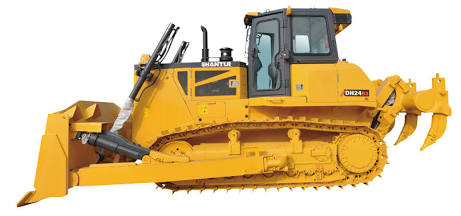
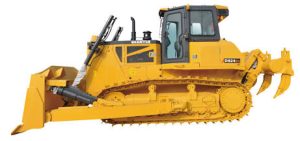
In the 240-to-265 horsepower crawler tractor class, procurement decisions traditionally pivot on legacy footprints. The Caterpillar D7 is an industry benchmark, famous for its elevated sprocket “High-Drive” architecture and high-tier electronic telemetry. However, engineering and fleet asset managers evaluating production economics must look closer at structural and drivetrain dynamics rather than brand prestige.
The Shantui DH24-B3 XL challenges this space by applying a fundamentally different mechanical philosophy. By replacing a complex torque-converter power-shift transmission with an electronically controlled hydrostatic system, it creates unique advantages in power-transfer efficiency and application versatility.
Below is a granular technical breakdown comparing the engineering mechanics of the Shantui DH24-B3 XL against the Cat D7.
1. Drivetrain Architecture: Linde Hydrostatic Drive vs. Cat Mechanical Power-Shift
The core differentiator lies in how engine power is translated into drawbar pull. The architectural contrast here dictating fluid power efficiency is significant:
- The Caterpillar D7 System: Employs a mechanical powertrain utilizing a torque converter paired with a multi-speed planetary power-shift transmission. While providing strong momentum in linear dozing cuts, it inevitably suffers from parasitic torque converter slippage under high resistive blade loads.
- The Shantui DH24-B3 XL System: Implements a dual-path, dual-circuit, electronically controlled hydrostatic travel drive system developed with premium hydraulic component groups (Linde technology). This eliminates the torque converter, driveshafts, and transmission gearboxes entirely.
From an engineering standpoint, the hydrostatic advantage alters site productivity. The system delivers completely stepless, infinitely variable speed regulation up to peak velocity. Under extreme blade resistance, the hydrostatic pressure automatically increases to match the load requirements without dropping engine RPM or forcing a physical gear change. Furthermore, it enables counter-rotation of the tracks and full power-turns, allowing the DH24-B3 XL to maneuver in tight geometries where a power-shift dozer loses track traction and momentum during steering clutch disengagement.
2. Engine Displacement & Torque Dynamics
When analyzing the torque profiles under peak drawbar load, engine displacement and injection stability become paramount.
| Engineering Dimension | Shantui DH24-B3 XL Spec | Caterpillar D7 General Target Spec |
|---|---|---|
| Engine Platform | Weichai WP12 Heavy-Duty Diesel | Cat C9.3B Engine Platform |
| Rated Net Power | 185 kW (248 hp) @ 2100 rpm | Approx. 197 kW (265 hp) @ 2200 rpm |
| Operating Mass | Approx. 23,800 kg to 26,400 kg (configuration dependent) | Approx. 29,700 kg |
| Standard Blade Volume | 6.5 m³ to 6.9 m³ (Semi-U Option) | Approx. 6.6 m³ to 7.4 m³ |
The Weichai WP12 platform utilized in the Shantui DH24-B3 XL features a large, high-displacement 11.6L 6-cylinder layout. While the Cat D7 relies on highly complex, high-pressure common-rail tuning (C9.3B) to maximize power density from a tighter displacement, the Weichai block leverages raw displacement size to generate high continuous torque at low thermal loads. For operations in remote territories, the direct-injection, turbocharged configuration provides massive tolerance for fuel quality variations that would choke or score the precise electronic injectors found on Tier 4 Final / Stage V common-rail networks.
3. Structural Load Paths: Conventional Chassis vs. Elevated Sprocket
The Cat D7 uses the iconic elevated sprocket design. This geometry successfully removes the final drives from ground-shock loads, but it adds secondary idlers and introduces a high center of gravity, which can accelerate track bushing wear during repetitive reverse high-speed tracking.
Shantui adopts a low-drive, conventional rigid crawler chassis frame. The ground contact length is optimized at **3,050 mm** with a standard track shoe width of **560 mm** (up to 660 mm available). This provides a ground contact profile specifically optimized for stabilizing the massive **6.9 m³ Semi-U blade**. Because the final drive centers are low and in-line with the track roller frame, the structural load paths pass linearly into the ground during heavy dozing cuts, minimizing vertical oscillation and track chain snaking.
Lifecycle Operational Cost & Field Maintainability Comparison
When procuring assets for demanding mining, road building, or quarry projects, the operational cost calculation extends far beyond initial fuel metrics:
1. Eliminating Software-Based Downtime
The Cat D7 requires a proprietary electronic software suite for basic drivetrain calibration and troubleshooting. A field sensor failure on an exhaust fluid circuit or telemetry module can immediately force the dozer into “derate,” bringing production to an absolute halt until a factory technician clears the software lockout. The Shantui DH24-B3 XL balances electro-hydraulic controls with clear mechanical architecture. Machine parameters are displayed via an intelligent touchscreen instrument monitor that features onboard self-diagnostics and open fault isolation, allowing a standard heavy equipment mechanic to repair faults right in the field.
2. Drivetrain Component Commodity Replacement
Because Shantui partners with premium global specialized suppliers like Linde for hydraulic travel components and Weichai for heavy diesel engines, the core drivetrain parts do not carry a restrictive proprietary markup. Over a 10,000-hour machine lifecycle, sourcing hydraulic pump cartridges, motors, and engine overhaul components through open distribution models reduces standard maintenance costs significantly compared to exclusive OEM supply chains.
3. Lower Initial Capital Risk
Amortization costs directly dictate project bid margins. A hydrostatic dozer like the DH24-B3 XL often enters a fleet at an initial purchase price 35% to 45% lower than a comparably configured D7. When calculating the asset depreciation alongside its high 6.9 m³ dozing capacity, the Shantui machine frequently delivers a superior net cost-per-cubic-meter ratio, making it a compelling, reliable choice for modern fleet managers focused on operational profitability.